Friday, December 30, 2011

The Bitter Orange of the East


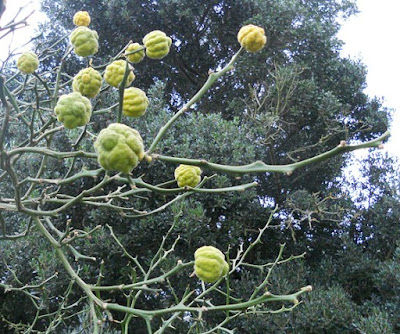
I missed the fragrant flowers and attractive autumn foliage on this one but with all the leaves gone even I can’t miss the warty, down-covered fruits.

It’s Citrus trifoliata, the Japanese Bitter Orange. I’m assuming it has leaves divided into three but as you can see in the next photo there is nothing but stem and fruit at the moment. Bitter Orange is well known for its thorns, which can be seen in this picture.


Bitter Orange belongs to the plant family Rutaceae, along with other citrus and boronias. You may be more familiar with this species when something goes awry at the base of your edible citrus; it’s widely used a rootstock, at least in the UK. It’s also been called Poncirus trifoliata, but these days we consider it a true Citrus, even though it sits out on its own a little within this genus. It certainly interbreeds successfully with other citruses, resulting in the following self-evident crosses (thanks Citrus Pages): citranges, citrumelos, citrandarins, citremons, citradias and citrumquats. For more on what is citrus and Citrus, see my post earlier this year.

The fruit of the Bitter Orange, called ‘karatachi’ in Japan, won’t kill you but I gather it’s…bitter. That part of the name is correct. You can make marmalade from them, or candy the peel as a spice. In China the fruit has numerous uses in traditional medicine. Just don’t expect to see them soon on your western supermarket shelves.

There is nothing quite like the Japanese Bitter Orange in Citrus, and when it was in its own genus Poncirus there was one species only. Despite the common name it grows naturally in northern China and Korea. As with a bunch of other geographically misnamed Chinese plants it came to Europe via Japan. The most famous of these is perhaps the Japanese Pagoda Tree, Styphnolobium (previously Sophora) japonicum, which has a misleading common and scientific name. The most famous specimen of Japanese Pagoda Tree is perhaps this one, in Kew Gardens, about to turn 250 next year (it’s one of Kew’s ‘Old Lions’, planted in 1762)


The easiest place to find a Bitter Orange at Kew Gardens is not far away, near the drinking fountain just behind the Orangery. I walk past it every day on the way to my office but only this morning did I notice its fruit, and indeed its very existence. That’s the great thing about working in a botanic garden, particularly one with 30,000 potential surprises.


Images: The Japanese Bitter Orange snaps are mine and taken yesterday. The Japanese Pagoda Tree is via Creative Commons and Flickr, and is a photo by Chris Guise (1967geezer) - my images of this specimen just don’t do it justice! 

Monday, December 26, 2011

Record breaking English oaks


Not surprisingly, an English Oak will be planted in the British Garden at the London Olympics (the topic of my recent posting). But not just any English Oak. This one is a descendent of the de Coubertin Oak.

When a tree gets it's own name you know the tree has either grown rather big and old, or has witnessed something important. The Bowthorpe Oak near Bourne, in Lincolnshire, is over 1,000 years old and has the largest girth (42 feet) of any English Oak (Pedunculate Oak) in Europe. The Royal Oak, growing near Boscobel House in Shropshire, was reputedly where King Charles II hid from the Roundheads - you can now see one of its reputed offspring.

Today I walked a mile or two along the three-mile long oak avenue, Queen Anne's Ride, in Windsor Great Park (I've illustrated this blog with photos from this walk and also, at the end, Warburg Reserve, about 30 miles away, which we visited earlier in the day).


The entire avenue is lined with England's most common woodland tree, Quercus robur.  The Ride dates back to 1708, when it was known as the Queen's Walk. In 1993 the Association of High Sherriffs celebrated their first millennia with a donation of 1000 trees to replace the ageing older oaks so it's now a mix of old and new, much like the whole Park itself.


But back to the Olympics and Ms de Coubertin. According to a media release issued last week, there are 4,000 semi-mature trees planted in the Olympic Park, as well as 300,000 wetland plants and (to use that well known unit of bigness) "in excess of ten football fields worth of nectar-rich annual and perennial meadows".

But the media release says "one of the most significant trees to be planted on the park is an English Oak that will be placed in the riverside Royal Horticultural Society Great British Garden that overlooks the Olympic Stadium". This is the ‘de Coubertin oak’, grown under the guidance of  Royal Botanic Gardens, Kew staff, from "an acorn collected from the tree that Baron De Coubertin planted to thank the citizens of Much Wenlock for inspiring the founding of the modern Olympic Games".

There will be some more of these Olympic inspiring oaks planted out in England in the lead up to the Olympics but more about that later next year...

For the full story on de Coubertin and his connection with the Olympics, read this link to a story from last year. In brief, de Coubertin was a Frenchman looking for a way to inspire 'today's kids' - back at the end of the nineteenth century. He found this inspiration in Dr Brooks, living in Much Wenlock (in Shropshire, home of the Royal Oak), and his 'Olympian games' that had been running for 40 years, since 1850. That inspiration lead to the start of the 'Modern Olympic Games' in Athens, in 1894.

The oak was planted in Much Wenlock by de Coubertin in October 1890, to celebrate his inspiring visit.

Quercus robur is not only the most common woodland tree in England, it is the commonest species of tree in Kew Gardens, with as many as in the Queen Anne's Ride avenue. You can find quite a lot of them in this interactive map and lots of other English Oak facts on the Royal Botanic Gardens, Kew website.

The final few images are from Warburg Nature Reserve, in the Bix valley (just past Bix Bottom as it happens), near Henley-on-Thames. This chalk grassland and remnant forest was named after the botanist Edmund Frederic Warburg (1908-1966) who co-authored a comprehensive Flora of the British Isles, in 1952. I haven't got a copy handy but I'm sure it has a lot to say about Quercus robur, which features in the Nature Reserve more than you might think from my pictures (the cute animals got in the way). 


Saturday, December 24, 2011

A flower and a stem, our white winter


This Winter Cherry next to St Anne's Church in Kew Green (the burial site of early Kew directors Joseph and William Hooker) caught Lynda and me by surprise this morning. From a distance I assumed it was a sorbus or some other tree with white berries. 


When I saw it was a cherry in flower, I assumed it was a cherry making a big mistake. Didn't it know it was Christmas! Wasn't it aware that the gloomy months of January and February are still to come? 


Luckily there was another near the Pagoda, inside Kew Gardens, with a name tag. Turns out it's a cultivar called Prunus x subhirtella 'Autumnalis', well known as the winter flowering cherry.


According to a Telegraph article by Ursula Buchan in 2007, the Winter Cherry flowers 'in flushes' from November to March, only stopping when it's really cold (which it isn't currently). Buchan also likes the autumn colour, which I'll look out for next year.


There are other odds and sods in flower around Kew Gardens: Viburnum, snow drops, and even some very early daffodils. As I mentioned previously, though, the colourful stems of the Cornus have been a revelation. And it's a stem that was the second plant to catch my eye today, the waxy white stems of a rubus.


Rubus cockburnianus has an unfortunate name, at least the way I pronounce it. Let's call it the White-stemmed Bramble. There are a few cultivars but I'm assuming our Kew one is the species itself.

It's a plant you hardly notice in leaf, but come winter its exposed stems are magical in the early morning light. Even in early afternoon today, it was photogenic...


Just a couple of white-coloured plant parts to make up for the lack of snow and frost. While a dusting of snow might be nice I'm happy with the trade off.

Friday, December 23, 2011

The best Olympic Games (parkland) ever


Bicentennial Parklands in Sydney are hard to beat as a biological Olympic legacy, but they are adjacent to the Olympic site, not really part of it. Here in London, the 200 ha Olympic site contains various gardens and parklands, so it may well be the best Olympic Parkland ever.


Two things (apart from the Boris sculpture above) make it very London and very good: canals and meadows. The waterways, including ponds and floodplains, make the site less like an aerodrome. The meadows will add colour and texture – even now, in mid winter they are pretty enough with dusty grasses and flat-topped umbellifers. 


On the southern side, the ‘2012 Gardens’ beside the canal are complex and symbolic. They represent the English flora, the North America flora and the rest of the world…well, actually the Southern Hemisphere as mostly found in South Africa. The contractor responsible for these, Willerby Landscapes, have taken great care to plant a colourful but diverse flora in each of the mini-biomes. If they match the enthusiasm and botanical knowledge of our guide today they will be plenty good. 

The picture at the top of the posting is the Southern Hemisphere sections with some sensitive sedges under the long poly tunnel and two Australian wattles (Acacia!) wrapped in plastic and picture just above is fine detail of the Southern Hemisphere ground cover.

The Northern Parklands fill the large area between the media building, the beautiful Velodrome (below) and the temporary ‘bubbly’ basketball stadium. They include more natural plantings – meadows, a frog pond (above, with the logs), fish trails through a canal flood plain, birch forests and manicured lawns for picnics. Here two different contractors have been at work, with botanical and landscape advice from University of Sheffield I gather.


This is what I learned yesterday. We were invited and led today by David Stubbs, Head of Sustainability for the London Organising Committee of the Olympic Games and Paralympic Games (LOCOG), assisted by David Lucas. With me from Royal Botanic Gardens Kew were David Barnes and Kath Smith. Here are David B, Kath and Dave S in their full protective gear.


Here am I, in my protective gear, through a mirror (on one of the new bridges) distortedly.


And as this is a primarily pictorial posting, a few more images from the site...


Sunday, December 18, 2011

Legalising the snowdrop trade in Georgia


ვაჭრობა თოვლი წვეთები საქართველოში. It's nearly Christmas, we had our first snow fall and the snow drops are out. On the down side, it's cold and snowdrops in Georgia are under pressure from over harvesting.


The cold is easy to deal with - more layers! And the shortest day of the year is six days away and then we are on our way towards that long summer twilight. At least that's the way I like to think about it.


As an aside, winter has been a revelation so far. I hadn't realised how beautiful Kew Gardens could look with the leaves blown off the deciduous trees, revealing stems of all colours and textures. In the weak winter sun it's like living in an etching. A stark beauty, but quite the antidote to the gaudy greens and showy blooms of spring and summer. By late February I'm sure I'll be willing back the flowers and leaves but for now I have my winter garden and frosty lawns to savour.


There are flowers of course. The snow drops are the most obvious but also Viburnum blooms - which should be called mini-snowballs - and some early daffodils.


Snow drops are the common name for species of Galanthus, a genus related to Amaryllis (Belladonna Lily) with about 20 species, most of them with white flowers.


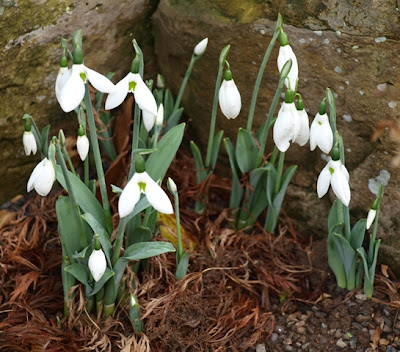
The Common Snowdrop, common by name and common by nature in at least UK and Australia, is Galanthus nivalis, native to Europe across to Ukraine and Turkey. In Kew Gardens, the snowdrop in bloom now (and illustrated here and at the top) is the Giant Snowdrop Galanthus elwesii, from similar areas but starting further east. 


The name refers to the tallness of the flowering stems not the flower size and I've seen it amusingly described as flowering in 'extremely early spring' - i.e. the start of winter - while the Common Snowdrop is described as flowering 'very early spring' - perhaps mid-winter. Some fuel for my seasonal musings...


Another popular snowdrop in UK gardens is Galanthus woronowii, native to Turkey, Russia and Georgia. Trade in all snowdrops (which I know sounds less exciting than cocaine or weapons) is controlled by CITES - the Convention on International Trade of Endangered Species - even though most are not actually endangered, yet. This picture of the species growing wild in Georgia is from Kew's head of Conventions and Policy, Noel McGough.


Following the break up of the USSR, Turkish traders headed into Georgia and snowdrops took their fancy. Snowdrops (in this case Galanthus woronowiiseemed to be common so they started to trade with contacts in the Netherlands, via Turkey. Georgians had other things on their minds at the time but eventually CITES asked the local authorities to review whether trade in snowdrops was sustainable.


Two years ago the Dutch government, Royal Botanic Gardens Kew, Microsoft Research and the government of Georgia surveyed wild and cultivated populations and decided that there was a potential harvest of 300 million bulbs. Based on this data, yearly harvest quotas and management regimes have been introduced and CITES has now agreed to Georgia continuing to export its snowdrop bulbs, under this new system.


Kew's relationship with Georgia continues, encouraging them to host a European Regional CITES Plants Committee meeting (picture below) to show off their approach to sustainable trading, and earlier this year brokering (as part of the Plants Committee) a successful meeting between Dutch bulb importers and Georgian traders.


Georgian snowdrops can now be traded legally and without leading to the extinction of the species in the wild. That's a good thing for us all.


In the meantime, here is my first snow in the UK, a dusting at Wakehurst Place and here along the M5...


Wednesday, December 14, 2011

From Greer on gardening to the blessing of a cake. Ah, London life!


Life in London is becoming as intriguingly unpredictable as Sydney, which is nice.

On Monday night Lynda and I listened to Germaine Greer tell us how to suck eggs - her words. What she actually did was show us how her property in south-eastern Queensland has been converted back into a self-sustaining rainforest. She also gave an interesting summary of vicariance biogeography, using the only the first of these words, and only once, thankfully. 

Greer has (good) form as a commentator on plants and gardens. In 1979 she wrote a gardening column for the magazine Private Eye under the pseudonym of Rose Blight, and she's been know to drop the occasional contribution into a newspaper on this topic.

Greer got into plants when she attempted to get closer to her sister, a trained botanist. All this did was cast Germaine's giant public shadow on her sister in her one area of specialism.

More productively, Greer bought some land - for the price of a London flat - in the headwaters of the Nerang River, near to Mount Warning, and upstream of Surfers Paradise. This is her Cave Creek property.

The talk was a mix of facts and a little fiction. As always Greer didn't let the facts stand in the way of a grand sweeping statement, or bother too much with consistency from one end of the talk to the other. For example weeds are welcome...except Lantana. Insect pests are welcome....except when they eat a seed you want to plant.  National Parks are bad because they don't lock up the forest...Cave Creek works because they don't just lock up the forest.

But I quibble. Greer was willing to stretch herself, to talk passionately about a subject that means a lot to her and is making a real difference. For that I can put up with some unscientific thinking. And I was on side with her dismissal of always worrying about rare species about to go extinct.

Greer finished by reminding us that if we see her doing things that seem odd and we wonder 'how could you' - such as Big Brother (picture above) - it's all in a good cause, for the rainforest restoration.

So that was the entrée. The main course, today, was cake. A large square cake with mostly light blue icing and the State of Tasmania floating on top. I was invited to the Annual Christmas Cake Ceremony at The Royal Hospital, Chelsea (the location of the annual Chelsea Flower Show).


This 61st cake ceremony was the responsibility of the Tasmanian people of Australia but because they don't have a consulate in London (it's interesting who does - WA - and who doesn't - NSW) it was handled by Australian Defence Staff in London assisted by the Hobart Branch of the RSL.

After a welcoming speech the cake was blessed, in rhyming couplets, by the Hospital Chaplain. Later we shared drinks and nibbles with the 'in-pensioners' - ex servicemen (and one woman that I noticed) who live in the hospital. You may have seen them featuring in a fascinating documentary on Australian television a year or so back.

The in-pensioners have to be over 65 years old, single and without dependants. The few we spoke to were charming and fun company. They are clearly proud of their home.


In the end we didn't get cake. That's for the in-pensioners later in the day, according to my source. We sang some songs (including the national anthem I don't know the words to and the one I was taught at primary school...) and then for us it was back to Kew and to wonder what would be next. Another cake (see Hooker)?

Friday, December 9, 2011

Sir Joseph by proxy


I was a little concerned to see that the first talk on a day honouring the life of Sir Joseph Dalton Hooker was all about his father. Sir William was a famous botanist himself, and also a Director of Kew Gardens, but amongst six talks could we afford a whole presentation devoted to dad?

As it turned out the main talks all swirled around Sir Joseph rather than targeting in on the man. I have to admit that 100 years after his death, it was a sound approach. We’ve read and heard about Hooker before, particularly in recent years on the coat tails of Charles Darwin. By using his father, changes to places he visited, his correspondence with Darwin, and re-examining his ideas on the flora of south-west Australia, was fresh and thought-provoking.

Whether Sir Joseph would have been amused is another question. Given what Paul White from the Darwin Correspondence Project at University of Cambridge said today, I suspect not - he was seldom amused. And Paul would know, having read all 1500 letters between Hooker and Darwin.


Bill Baker started things with something a little more direct, describing Hooker as the greatest botanist of his time and perhaps of all time. A big call, which I won’t dispute here other than to say that Darwin gently chastised Hooker for being reluctant to generalise and synthesise, albeit in the roundabout way of saying that he showed admirable constraint from doing what many did badly and too much.

Part of Hooker’s reluctance to speculate was a desire to have all the data at hand. For him that meant describing all the species left to describe in the world. Steve Hopper pointed out that Joseph Hooker described something like 12,000 species, more than 3% of the known species of flowering plant on Planet Earth today. But even with his prodigious output the task was beyond him.

[This reminded me of a story we were all told by Dr Gerry Kraft in the first year of our marine botany course at the University of Melbourne. Bryan Womersley, a man of Hookerian stature amongst Australian phycologists, started life as a rocky-shore ecologist but realised he couldn’t do any sensible ecology until he knew all the seaweed species. Bryan died in January this year, aged 89, and having only recently completed the last of his seaweed flora volumes for southern Australia. He never did return to ecology.]


So what did I learn today other than he had a father, things have changed since his time, he helped Darwin and south-western Australia is a fascinating part of the world (with apologies to all speakers who I rush to say did superlative jobs at saying much more than this!)?

From Anne Secord, also from the Darwin Correspondence Project, I was reminded of Sir William’s fascination with mosses and other bryophytes, and that Joseph, at age 5 or 6, was grubbing around in a wall looking for the moss Bryum argenteum which he knew from his father’s collections.

Peter Donaldson from Jute Productions talked about his retracing of Hooker’s trip to Tibet (which Joseph did on foot, all 350 km of it) where he (Hooker) discovered 20 species of Rhododendrum and began a world craze for the genus. Hooker was touring the region six years before Mount Everest was measured and named – in his notebook he list the tallest mountains know at the time with Kinchinjunga at number one and an unnamed mountain (Everest) at number two. Hookers sketch of the mountain in 1848 is thought to one of the first recorded views of Mount Everest by a European (and you can see it on display at the moment in a special Hooker exhibition in the Shirley Sherwood Gallery of Botanical Art).  Donaldson is editing a film on Hooker which we hope will appear on Channel 4 very soon.

From Paul White I also learned that Hooker's early letters to Darwin were long, detailed and designed to impress. It was to Hooker that Darwin used his famous ‘like confessing to a murder’ line when concluding that species are not immutable – the basis for evolution by natural selection. While Darwin’s letters, like his life, were padded with references to illness and health issues, Hooker’s were heavy on administrative and bureaucracy. Apparently Hooker’s letters give a very good account of what and who annoyed him.

Both Hooker and Darwin had an abiding love of plants, even though they worked with them differently, as White put it. For Hooker, it was all about classification, for Darwin it was plant behaviour and speciation. In 1864, when Darwin was convalescing after a particular severe illness, a twining plant in his room provided the only condolence. Hooker talks about his utter despair at being forced to collect crustaceans when the HMS Erebus was not at shore (Sir Joseph did collect some seaweeds on his travels so life at seas wasn’t all a botanical wasteland!).


Finally we heard from Steve Hopper, Kew’s 14th Director, telling us Hooker was a ‘lumper’ – i.e. he had a very broad species concept. For example, if things could hybridise he would prefer they were in the same species, even if they looked a little bit different. Hookers view was that good taxonomy could only be done by someone with a large herbarium collection from many countries. He had little time for the, usually Colonial, ‘splitters’ who introduced ‘unnecessary detail’.

I particularly liked a quote from one of Hooker’s letters: ‘ The more I study the more vague my conception of a species grows and I've given up caring whether they are pups of one generic type or not’. As Steve said, we’ve all been there.

Hooker didn’t quite appreciate the true floral diversity of south-west Australia but he did think that when better know it would be considered ‘the most peculiar on the Globe and quite distinct from NSW’. Quite, and Steve went on to show how peculiar it is and explore why it might be so.  A fascinating talk, and nice to see our Director talking about his scientific passion rather than Kew’s corporate objectives. Both are essential, of course, as his directorial ancestor Joseph Hooker understood and relayed regularly to his eventual confident and close friend, Charles Darwin.

After a tour of hookeriana in the herbarium and library, Phil Cribb and Jim Endersby finished off the formal part of the day before an event at the Shirley Sherwood exhibition (mentioned above). Phil spoke on...orchids (he's Kew's and perhaps the world's pre-eminent orchid expert). Jim, on his book Imperial Nature: Joseph Hooker and the practices of Victorian science which I can confirm is a hoot of a read - I referenced this book in a couple of postings in 2010. 

From Phil Cribb we heard that Hooker shared with Charles Darwin his observations on orchid pollination and then when Darwin published his major orchid volume reviewed it extremely favourably! Hooker also appointed the first orchid specialist at Kew, Robert Allen, and as throughout the plant world had plenty of orchids named after him - most strikingly, Sirhookera lanceolata. Hooker was a talent spotter, collector, networker, scientist, expeditioner, and great believer in long-term projects.

Jim Endersby's asked 'Why should we care about Hooker?', then answered his question: Hooker is more typical of a Victorian man of science than many of his out spoken contemporaries (such as Thomas Huxley) and not keen on government funded positions. Hooker himself takes advantage of opportunities as compensation in the absence of an independent fortune. He wasn't keen to toe the government line - he wanted to employ whoever he wanted and to pick the tradesman he liked (not big on 'due process' I gather). Kew was effectively a 'snug little place' for the Hooker family. 

My final picture below is some of the current Hooker family, warmly welcomed by everyone at the conference.


Images: My version of Sir Joseph by proxy: the cake today, Crinodendron hookeri (Eleocarpaceae), the Hooker-ornamented mantle-piece topped by one of his paintings in the Kew Director's residence (with current Director) and a blue-stained freshwater red algal species Batrachospermum antipodites  (a representative of which Hooker collected from New Zealand in 1855). In the final picture, three of Joseph Hooker's granddaughters are cutting the proxy cake.

Wednesday, December 7, 2011

The species most responsive to change


Today's quote on the back page of the East African edition of Business Daily is from someone described as an English naturalist. "It is not the strongest of the species that survive, nor the most intelligent, but the one most responsive to change", said Charles Darwin.

Surely this sums up the future of Africa, and indeed of the whole world. I would add that a little intelligence, and strength of will, won't go astray.

This is post follows on my last, Seeding Africa, and is being written at the end of the indoor part of Kew's Millennium Seed Bank International Forestry Workshop in Nairobi.


Clearly there is a huge need for planting trees and forests in Africa. Deforestation continues, albeit at a reducing rate, and forests are needed for the livelihoods and survival of most Africans. New trees must be the right ones (either indigenous or unlikely to cause additional harm to the environment), from quality sourced and stored seed, and able to grow and reproduce by themselves over time.

Already community engagement is strong is all the projects reported to the workshop and this has to remain part of any successful tree-planting programme. Government support at highest level is important, but only if backed up with funding and clear policy direction (with out these it can be more harmful than good in the longer term).

Partnerships within Africa will continue to be important, as will those with the 'facilitating partners' or what are sometimes confusing referred to here as 'multinationals' (e.g. Kew's Millennium Seed Bank, Forest and Landscape Denmark, Food & Agriculture Organisation Rome).

In most countries there is now a good track record of delivery on the ground and this is the strength of the emerging network in Africa.

Many of the trees planted can be described as 'useful plants' and work will continue on collating existing uses and finding new ones. Of course these plants can be useful directly or for earning revenue: forest industries contribute US$468 billion (1%) to the world economy each year, including $75 billion from pharmaceuticals of 'natural origin' and $15 billion in trade of wildlife products.

There are hurdles and bumps in the road of course (literally plenty of the latter in Nairobi at the moment!). Funding is also short. It is increasing difficult to get seed in some areas - excuse the pun, but all the low hanging fruit have been collected. There are problems in some regions with seed supply and quality. Technical support is always in short supply, and greater access is needed to markets and customers.

Against this background the group was keen continue, and to expand its work. It was agreed that we need to form a consortium of technical partners that can 'deliver on the ground'. To do the delivering we need strong leadership, quality assurance (throughout the process - from seed to seed!), technical expertise, ability to up the scale of activity, and a package that appeals to donors and customers.

What sets this group apart from others planting trees in Africa is an emphasis on quality and on the 'right plant for the right place' (often Indigenous species but at least suited to environment and sustainable). Innovation and biodiversity conservation will be encouraged.

So that's where it sits towards the end of an informative, inspiring and invigorating workshop. May we be strong, intelligent and responsive to change!


Images: Something that used to be called Acacia and some things that are probably still storks, in Nairobi yesterday.

Monday, December 5, 2011

Seeding Africa


There are some 675 million hectares of forest in Africa, now. This forest (only one tenth of it primary natural forest these days) is being removed at the rate of 3.4 million hectares per year - for firewood, timber , unsustainable food and medicinal harvesting, and urban expansion.

The decade before last the forests were being 'lost' at a rate of 4 million hectares per year, so things have improved, a little. Just as important are efforts to plant forests, either where they were before (reforestation) or in new places (afforestration), particularly with local species.


Apart from political will and progressive policy, what Africa needs are skills and expertise. That's the big message from 'Forest 2011', the pithier title of Kew's Millennium Seed Bank International Forestry Workshop on Afforestation in Africa: Constraints and Opportunities.

I'm at the World Agroforestry Centre in Nairobi, Kenya, attending the first three days of this five-day workshop. This means I'll spent my entire first visit to Nairobi in hotel and conference rooms, or travelling between the two. But for a good cause.

What we want? A technical partnership. When to we want it? Well, yesterday would have been good. Discovering and sharing technical information seems to be at the core of the workshop and what this group of representatives from 12 African countries wants.

From a seed bank perspective it's not enough to bank the seeds. You all knew that I hope. The Doomsday Vault concept might be a good way to get attention on seed banking but it isn't the end game. It was clear from the talks today that many of the seeds are difficult to store and germinate, and attention is needed on the care of new plantings and creating a regenerating vegetation (preferably of local species).


Two examples so far. Burkina Faso, in tropical west Africa, has a human population of 14 million, relying on 7 million ha of forest. It's true to say 'relying on' because 97% of people depend on forest resources for energy. In addition 80% of the population are farmers, and forests are lost at the rate of 100,000 ha per year for both energy generation and agriculture.

Burkina joined the Millennium Seed Bank Partnership in the year 2000, with the signing of an Access and Benefit Sharing agreement. Since then 80% of their flora has been collected, including many rare and endemic species threatened by non-sustainable use. A living collection in Burkina Faso has also been created to provide additional domesticated wild species for local use, as well as a local herbarium and information database. Along the way three PhDs have been completed, formal and informal training has been provided in-country as well as Burkina Faso staff spending time in Kew laboratories.

In the United Republic of Tanzania, in eastern Africa (just south of where I'm now sitting), there are 16 million hectares of gazetted forest reserves, but another 16 million hectares of 'unprotected' forests. Biodiversity conservation is now part of the government forest policy and the President promotes the use of indigenous plants. More than 700 million trees have been planted over the last five years, with a mix of local and exotic species. The Tanzania Tree Seeds Agency, part of the Millennium Seed Bank Partnership,  has in five years (I think) already provided 91 tonnes of seed from 200 tree species, 60% of them local.

There is a concern swirling around in my mind about planting indigenous tree species in places where trees have never grown before (afforestation) but maybe that's just an academic question for less urgent times. Carbon offsets and fighting climate change may be enough to silence my doubts, and that was a topic of discussion today.

So far the mood and analysis is positive. It's still true, as the lady next to me on the plane over said, that the destruction of African forests is continuing at a depressing rate. But it is reversible. 


Images: my first three pictures are from the Drakensberg in South Africa, and Lesuto, taken the last (and only other time) I'm been on the African continent, in 2005. The final picture is from the Karoo Desert National Botanical Garden in South Africa, from the same trip.

Thursday, December 1, 2011

Bougainvillean variations


I could find only one link to botany in the collection of scientific souls competing for attention beneath the Pantheon in Paris. The French respect their intellectuals of course, and our subject shares the giant basement under Foucault's oscillating pendulum with the likes of Messrs Voltaire, Hugo and Curie.


As you might have guessed by the first photo, I'm talking about Louis Antoine de Bougainville, who lived from 1729 to 1811. He sailed around the world in 1766 (arriving back in Paris three years later), claiming the Society Islands (including Tahiti) for the French.


While Bougainville was still circumnavigating the planet, his friend Philibert Commerçon named a Brazilian climber with showy bracts after this already famous Admiral. Bougainvillea was introduced into cultivation in Europe in the early nineteenth century and I gather thanks to Kew Gardens soon became popular throughout the world.  

As for Louis Antoine himself, I don't know that he had any great love of plants, but I stand to be corrected (you know where the 'comment' button is!). However I can give you one, slightly tenuous, link between the Bougainville family and botany. Louis Antoine's son, Baron Hyacinthe, visited Sydney's Botanic Garden in 1825 and for the full tale of romance and intrigue by Pamela Mawbey take a look at the Royal Botanic Gardens and Domain Trust, Sydney website.

Since this is becoming almost a Fugue, one further variation. The picture of Bougainvillea at the head of this blog was taken in March 2004, while visiting the Xishuangbanna Tropical Flowers and Plants Garden in southern China. The Garden is not far away from the 900 hectare Xishuangbanna Tropical Botanical Garden, China’s largest botanic garden. The Flowers and Plants Garden, however, is not considered by locals botanists to be a botanic garden.

It's a beautiful garden, with most plants named and labelled, sometimes with a bit extra about their economic use or value. But because the plants are not wild sourced and the record keeping poor in comparison to the Botanical Garden, and the research (agricultural and essential oils) limited in scope and quantity, my Chinese colleagues refereed to it as ‘only a Bougainvillea garden’. Could be worse!