Saturday, December 27, 2008

Seasoned greetings


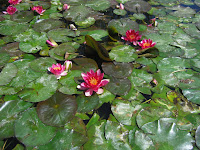
Photo: Sydney's Royal Botanic Gardens on Boxing Day 2008
One topic I'd like to return to regularly in this blog is an appropriate set of seasons for Sydney (and beyond?), and I'd welcome comments and feedback. I talked about this in early August, trying to convince Sydneysiders that spring had already started in the local bush and in our gardens. Unfortunately we had a particularly cold winter and not many people were convinced.

But as happens every year, the first flush of post-winter flowering began in late July and early August. Most of the wattles at our Mount Annan Botanic Garden blossom in August. It's the time of year when people start to wonder if it has been an early spring, again...

Of course there are plants in flower all year and you'll find plenty of local species flowering in July, August, September, as you will in your garden. Our spring walk at the Royal Botanic Gardens is usually at its peak in mid to late September. And you can plant your bulbs early for an early flush. Still, it's around early August when you get the sense that a change is taking place and there is a shift in the 'season', at least from a plants point of view.

Flowering will depend on recent rainfall, temperature and day-length. It will usually depend on what happened at the time of flower bud formation, rather than what is happening when the flower opens. It's a complex business and some species are more variable in there flowering time than others.

Now that the Hyacyinth Orchid season is with us, or just passing, we are about to head into 'high summer'. In past years that would have meant intense heat and dryness. This year, we seem to have a return to a wet steamy summer. For plants, what does it mean? Maybe we need an iconic and reliable plant event for each month of the year as starting point. The most significant of these could be used to define some Sydney Seasons, and a start to us moving away from the European-centric system.
As I've tentatively suggested in the past, moving Wattle Day from 1 September to 1 August could be one way to make a point - although this would draw intense historical and geographical argument. I'm inclined to side with correspondent Jim Nicol who thinks this change would not only help separate our celebration of the local flora (and local conditions) from the traditional start of spring in Australia, but also match the flowering season for wattles around Sydney. Now of course my interstate colleagues are not always as convinced, depending on their local conditions.

In any case, this is all very well if your life, like mine, centres around plants. But our sense of seasons is not just determined by flowers and autumn leaves. This was the problem with me announcing the start of spring in early August - it was very wintery weather. Do we have a separate plant season system (for gardeners or nature lovers) or do we try to combine all the signals into a single system that could replace our traditional summer-autumn-winter-spring?

I've mentioned already correspondent Rick Kemp (23 November 2008). He favours a system of five seasons, based on a range of climatic and biological cues, with 'spring' beginning (as I think it should) in August. Rick's additional season is a 'pre-summer', in October and November, but I won't give away his entire system here. It would be interesting to see what other ideas there are out there.

There is also some nice science to be done. One of the likely consequences of accelerated climate change is a change in seasonal patterns, part of what is also called 'phenology'. By coming up with a system of seasonal plant events we may be able to identify some good targets for monitoring and testing to see if they change.

I announced the start of a phenology project in the Friends of the Gardens magazine, The Gardens, mid way through 2008, but we've been a little slow off the mark getting it started. Behind the scenes we've been working with other botanic gardens and Earthwatch to devise a list of national target species, and early in 2009 I'll be getting back in contact with those who've expressed interest in assisting us. We might add to this list with some Sydney favourites and perhaps a few species to help us define our local seasons.

Wednesday, December 24, 2008

Dinner with Darwin


Only a few more days until we begin a year of Darwinic celebration, and cogitation. The year 2009 marks 200 years since the birth of Charles Darwin, and 150 years since the publication of The Origin of Species. And we all know what that means - apart from him being 50 when he published 'the book', and me fast approaching that age without that kind of publication in mind...

From now to next Christmas will be wall-to-wall Darwin events. We have plenty lined up at the Botanic Gardens, including debates and talks, garden displays and art, and first up a fancy dinner with some of the brightest and entertaining guests on the planet.

Invest in your mind, and book in for dinner on 11 February 2009 (sponsored by the Botanic Gardens Trust and the Australian Museum):

Sunday, December 21, 2008

Summer plants


Just a few more photos (see the posting on trigger plants below) from this morning's walk through Sydney bushland: the flowering stalk of a local hyacinth orchid, Dipodium variegatum (see posting below about another local species, Dipodium roseum); the bronze new growth on Banksia oblongifolia ; the christmas bells of...Christmas Bells (Blandfordia nobilis); and the blue berries of the Blue Flax Lily, Dianella caerulea.

Fastest plant in the world

What's the difference between these two pictures?


If you haven't heard of trigger plants, you should have. The genus Stylidium is the fifth largest genus in Australia in terms of species – after Acacia, Eucalyptus, Grevillea and Melaleuca.

It is also arguably the fastest plant in the world - the difference between these two pictures happened in less than a blink of the eye.

Botanist Juliet Wege, at the Western Australian Herbarium, has discovered more than 20 new species of Trigger Plant in recent years, all of them in south-west Australia which has nearly three-quarters of all Trigger Plant species. There are a couple of species in Asia, quite a lot in northern Australia, and only four around Sydney.

I gather the first species was discovered in Botany Bay in 1770 by Banks & Solander, and if you look in various plant guide books they usually say there are 110-140 species in the genus Stylidium. Juliet Wege says there are at least 230 known species and maybe another 70 to be discovered.

Trigger Plants are in flower now around Sydney. Look for a stalk of small pink flowers up to half a meter tall sticking out of a tuft of coarse ‘mondo grass’-like leaves. On the Hawkesbury Sandstone the leaf tuft is at the end of a short stem, and this is a different species to the one found on clay and other sandstone (with the leaf tuft right at the base). The flowers look a bit like a little butterfly, with 2 pairs of petals (there is a fifth which is small and hidden), but they also have this amazing ‘trigger’.

The trigger is made from the fused female and male parts of the flower (the style and the anther filament). When an insect, or tiny stick held by a child or excited adult, touches the sensitive area at the base of the trigger, it flicks back into the middle of the flower dumping pollen on the insect (or relieving the insect of pollen from an earlier flower). Look at the front flower in the two pictures I took this morning and you see the trigger cocked on the left, and released (by an excited adult) on the right.

Apparently this response happens within 20 milliseconds of the area being touched! It will reset itself, slowly, taking about 30 minutes. But it may not be receptive to touch again for another 30 minutes after that.

If you are wondering, the rapid response seems to be due to the collapse of specialised cells rather than a slower change due to osmotic potential differences (where cell walls are elastic and expand and contract as salt concentrations varied) which is responsible for plant responses such as sundews enclosing their insect prey.

Friday, December 19, 2008

Jungle Party

Lynda and I drove up Bells Line of Road listening to C.W. Stoneking's Jungle Blues, but we needn't have been concerned. The Mount Tomah Botanic Garden staff christmas party, at the newly acquired 'Jungle' property to the east of the main garden, was a festive occasion. Plenty of food, including the traditional Tomah spit, and the sun setting over yet another spectactular view in the mountains.

A substantial donation by John and Libby Fairfax, supplemented by an Environmental Trust grant, allowed the Botanic Gardens Trust to finally add The Jungle to Mount Tomah Botanic Garden. By March 2009 the Jungle Walk will be reopened - celebrating 80 years since it was first opened as the Fairfax Walk.

This year Mount Tomah saw the official opening of the Waratah Education Centre, further progress on planning for the joint National Parks/Botanic Gardens 'World Heritage Exhibition Centre', the first stage of the new Woodland project, and plenty of other gardens and paths - look out next year for the classy path and boardwalk leading to The Jungle.

As for what happened at Mount Annan Botanic Garden, Royal Botanic Gardens and the Domain, you'll just have to read the annual report (http://www.rbgsyd.nsw.gov.au/welcome_to_bgt/quick_links/publications/2007-2008_Annual_Report).

Wednesday, December 17, 2008

Size matters

Are small leaves somehow related to the phenomenon of ‘sclerophylly’ (tough, thickened leaves that seem to be adapted to dry, hot areas of Australia with poor soils)? Anecdotally this seems to be the case – as you head inland (where conditions would favour sclerophylly) you tend to get a predominance, but not an exclusivity, of smaller leaved plants.

Wade Tozer from Macquarie University spoke today at the Royal Botanic Gardens about his work (with Mark Westoby from the university, and Peter Weston and Darren Crayn from the Botanic Gardens Trust, the later now in Cairns) on this subject.

The short answer is possibly not. Wade devised a clever test using pairs of closely related species (based on their evolutionary trees) where one species had significantly wider leaves than the other. Using 25 of these pairs he looked for correlations with temperature, rainfall and soil, as well as various plant structural features. What he found was no proof of any relationship between leaf size and sclerophylly, or leaf size and the things that seem to encourage sclerophylly.

This doesn’t mean an interesting relationship doesn’t exist – it might be obscured by other patterns or the analysis might not be robust enough – but it certainly can’t be taken for granted.

William Carron (1821-1876)

Today I met with Tony Pryce, grandson of William Carron. Carron was one of the few survivors of the Kennedy ‘ill-fated’ expedition to Cape York in 1848, and wrote a narrative of the trip. Relevant to us, he was employed as a plant collector between 1866 and 1875 by Charles Moore, and lived for a while in one of the Gardens’ cottages. He was probably also our first or second Librarian.

Carron collected extensively in northern New South Wales (he was an early critic of the over harvesting of Red Cedar), and visited Lord Howe Island with Moore in 1869.

Mr Pryce is collating all the information he can find on Carron’s life, right up to his death in Grafton in 1876. The Mitchell library holds manuscripts of Kennedy and notes and publications of Carron. The Royal Botanic Gardens library is sure to hold a few gems as well.

Historian Lionel Gilbert has written extensively on Carron’s life, although only some of it has been published.

Tuesday, December 16, 2008

2016 - the book

We've already started to think about what kind of book we need to celebrate the bicentenary of Sydney botanic gardens in 2016. There may be more than one, but we have in mind a publication with lots of pictures, quirky stories and anecdotes. At this stage we favour essay style articles on all aspects of the organisation, from crime to controversy.

Already some of our honorary associates and volunteers are gathering oral histories - I even had a chat the other day. Some of the gems from these recordings will be used in the book. And we've set up a series of folders (electronic of course) to hold notes and documents for the 20 chapters we've identified.

If you know something about the botanic gardens you think we may have forgotten, or perhaps never known in the first place, send me a message.

Sunday, December 14, 2008

More cacti


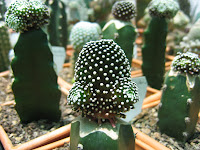
Photo: Like Christmas tree lights, Mamillaria ivethyi grafted onto another cactus in Ian Hay's collection.

Today was the Cacti and Succulent Society's Christmas lunch and auction, at Hamilton's World of Cacti in Llandilo. Hamilton's supply plants to Bunnings and other major outlets, but also grow lots of fascinating rare and unusual plants. The President of the Society, Ian Hay, keeps his spectacular collection here.

Lots of great plants to see and, as I've said already in this blog, a wonderful group of people. As always, plenty of food!

The main attraction is the auction, where plants common and unusual either go for a song or attract amazingly high bids. You have to know which is which, and my succulent tastes are not yet that cultivated... Still I bought a few bits and pieces - a lithops, a cactus, a euphorbia and a Stapelia. I'm on a mission to keep a lithops alive for a year. At each of the December talks I give I buy one but so far none of them have made it to the next December.

Saturday, December 13, 2008

Flying foxes

In response to the St George and Sutherland Leader story on the local council rejecting our request for areas within the region to be available if the flying foxes are relocated from the Royal Botanic Gardens, I wrote the following letter:

"While it is true that the Botanic Gardens Trust has applied to relocate its camp of flying-foxes from the Royal Botanic Gardens, Sutherland Shire residents should rest assured that sensitive areas such as the existing campsite at Kareela were not listed in our application as preferred sites.

Our original list identified more than 200 sites within the Sydney metropolitan region where these highly migratory animals might relocate. This list was sent to land managers (including local councils) to confirm which of these sites may be suitable for a flying-fox camp (where flying-foxes gather to sleep and breed during the day).

The Trust's proposal is to move the flying-foxes on from any places considered to be inappropriate for a camp within the constraints of licences issued. The technique proposed was successful in Melbourne, and was effective in Sydney between 1992 and 1997 (after which the Trust mistakenly stopped disturbing those few flying foxes that returned, thinking the population would remain at a few hundred).

The Grey-headed Flying-fox is listed as a vulnerable species due to its declining overall population, and it is important we help them find suitable alternative campsites if they leave the Royal Botanic Gardens."

The story was generally accurate, and I was interviewed as part of its preparation, but I needed to correct some of the information taken directly, and misinterpreted, from the relocation licence application.

If you want to find out more about flying fox relocation proposal, including information on why the trees in our living collections are important and why the relocation is necessary, see: http://www.rbgsyd.nsw.gov.au/welcome_to_bgt/feature_stories/questions_and_answers.

Thursday, December 11, 2008

The future of seedbanking

Today I attended the first day of a workshop at Australian National Botanic Gardens in Canberra to plan and fund seedbanking in Australia. Progressively since 2001, the major botanic gardens in Australia, along with various environment departments and other partners, have set up seedbanks for our native plants in most capital cities.

The seedbanks are funded through a mix of State, Commonwealth and Local Government funds, sponsorship and philanthropy, and a large contribution by the Millenium Seedbank (at Royal Botanic Gardens Kew, in the United Kingdom). The Millenium Seedbank has been critical in establishing many of the seedbanks and in establishing a network with the slightly sporty name of 'AUSCAR'.

All very good, but the first stage of Millenium Seedbank funding is coming to an end. The Australian seedbanks need to find local funding, as well as work with Royal Botanic Gardens Kew to secure more international support if possible.

The meeting today was very productive and the group will consider the various governance options on offer - including having the multi-partnered AUSCAR report up to the Council of Heads of Australian Botanic Gardens, then through to a Ministerial Council committee. While the Climate Change Strategy produced recently by the Botanic Gardens (see below somewhere...) will be an important part of this reporting, the seedbank has many environmental applications.

More on this later but the group today was enthusiastic about the future of seedbanking.

Wednesday, December 10, 2008

Joy Everett retires


Photo: Simon Goodwin.


After 28 years with the Botanic Gardens Trust, botanist Joy Everett retires tomorrow. To honour the occasion Joy planted a Wollemi Pine just outside Victoria Lodge today - the very first Wollemi Pine to be planted in the Domain.


Joy is well known for her work on the daisies (Asteraceae) and grasses (Poaceae), and various other plant families. She also edited the Trust's scientific journal for plant systematics and taxonomy, Telopea, for a number of few years.

Tuesday, December 9, 2008

Space seeds on their way, slowly

Astronaut Greg Chamitoff is now feeling much better after a week back on earth. Apparently for the first few days on earth after spending a months without gravity you feel like there are sandbags piled up on you when you lie down.

It will be interesting to see how our seeds respond to the same transition. We thought the ionising radiation might have some effect but perhaps the lack of gravity - and the ungainly reversion on return to our weighty planet - will be more important.

It looks it will be some time before the seeds make it back to Mount Annan Botanic Garden. All the cargo has to be carefully unpacked and catalogued before it returns to its owners. This might take a month. And then there is quarantine - getting the seeds from the USA to Australia might be the most arduous part of the journey.

Saturday, December 6, 2008

Cacti and Succulent Society of New South Wales


As patron of the Cacti and Succulent Society of New South Wales, I'm invited each year to speak to their December meeting. I've think I've done it it every year since I've been Executive Director and I perhaps one year in the place of previous Executive Director Frank Howarth.


President Ian Hay is always very welcoming, and the whole society is enthusiastic and friendly - it's a pleasure to speak there. And they tolerate me talking about things other than cacti and succulents, although I usually manage to squeeze a few in.


This year I talked about the World's Best Botanic Garden. I've given this talk a few times this year but I peppered this version with extra succulent pictures, particulalry from Les Cedres, a private botanic garden at St Jean Cap Ferrat (near Nice in France).
(The plant label refers to a specimen collected by the owner, Ms. Julian Marnier-Lapostolle, of Grand Marnier fame.)

Friday, December 5, 2008

Christmas natives

It's that time of year again. The time when people start to question the use of 'exotic' Christmas plants and look for Australian native alternatives. While anything other than a plant from your local area is an exotic, even if Australian, there are a few iconic Christmas plants from our continent.

The Christmas Bush (Certaopetalum gummiferum) is one of the best known. It's just finished flowering and the red fruits will ripen in time for Christmas. Christmas Bells (Blandfordia grandiflora) is out already in the local Sydney bush.

If you want a holly alternative, consider the Holly Grevillea (Grevillea aquifolium), Holly Leafed Fuschia (Graptophylllum ilicifolium) or Dovewood/Native Holly (Alchornea ilicifolia). Or for that matter, any plant with a species name 'ilicifolia/um' or 'aquifolia/um', which means leaves like a holly! None of these have fruits quite like the European Holly but you get the same general feel.

As for the Australian Christmas Tree, I'd have to suggest the Wollemi Pine (Wollemia nobilis). It will live in a pot for 10 years or so if you keep it trimmed and well fed.

Thursday, December 4, 2008

Collection of collections


[Andy Muirhead and Donna Osland. Photo: Simone Cottrell]


Last night, Andy Muirhead, host of the ABC's Collectors program officially opened our collection of staff collections. This beautifully designed and created exhibition will be on display until Friday 19 December. See pigs, sheep, shaving equipment, orchids, concert tickets, fridge magnets, nautilises and pop-up books, to name a few.


Around April next year you can see the highlights of the exhibition on ABC TV. As we said in our media release: "I'm not surprised so many of the Trust staff are collectors."

“The Botanic Gardens is all about collections. We have nearly 200,000 plants in our three botanic gardens and the Domain, representing 20,000 different kinds of plants from all other the world. These collections are enjoyed by eight million visitors each year.

“And there is much more behind the scenes. The National Herbarium of New South Wales has over 1.2 million preserved collections representing the discovery of our flora right back to the time of Joseph Banks. There are over five million seeds in our Seedbank at Mount Annan Botanic Garden and a rich collection of books, archives and artworks in our library,” Dr Entwisle said.


“These collections underpin the scientific research and botanical information service of the Botanic Gardens Trust. They also provide a vast database of knowledge for monitoring climate change. The Seedbank and living collections provide a safety net against species loss.”

“It’s hard to not be infected by the collecting bug,” Dr Entwisle said, a collector in his own right of algal specimens from around the country."

Wednesday, December 3, 2008

Monet's Water Lilies and more


This is a long-winded post I'm afraid. A couple of people have asked to see the notes I used for my talk tonight as part of the After Hours series at the Art Gallery of New South Wales. If you like your information aurally, you'd best wait until the video of the talk is posted online at: http://www.artafterhours.com.au/next/multimedia (probably next week some time). But, if you can't wait....

MONET’S WATER LILIES AND MORE
Art Galley of New South Wales
Tim Entwisle, 3 December 2008


Let me start by saying I haven’t visited Monet’s Garden in Giverny…

I did receive my invitation to speak at the Gallery while I was sitting in a Paris apartment, a short walk from Gare Saint-Lazare, preparing to fly back to Sydney that night.

I was holidaying in France with my wife Lynda, who unlike me (as will be obvious already), does speak French.

Just the day before we’d decided to visit Versailles (with the fountains running and period music – quite fun), instead of Giverny, and there was no time left to visit Monet’s garden.

The slides behind me are mostly water lilies or similar plants from various gardens around the world, including a borrowed picture of Monet’s Garden, with a few other relevant pictures thrown in. They are to divert you when I mispronounce French words…

As you’ll see in the pictures, we did manage to visit the Orangerie, and saw Les Nymphéas. These are the giant water lily paintings from the very end of Monet’s life and as my artistic friends here at the Gallery tell me – thanks Sheona White, Terence Maloon and Jethro Lyne – Monet started with landscapes and moved almost microscopically towards the lily pad.

Using this iconic image Monet made pictures towards the end of his life that could be the universe, a lily pond or perhaps even the insides of a plant cell.

* * *

But I readily accepted the invitation. It’s always a pleasure to visit the Art Gallery of NSW, and to of course to talk about plants. The galley is quite like the botanic gardens, except there are artworks instead of plants, it's mostly indoors, and more people come to hear me talk…

Interestingly, botanic gardens sometimes get criticised for putting all those lovely labels on our plants - it looks like a graveyard some people say. But it’s the same here of course. In the botanic garden we could have the plants without their labels and in theory you could enjoy the plants, or artworks, based purely on merit. Beautiful flower, beautiful painting.

But of course knowing who painted a painting, when it was painted, and maybe even why it was painted adds something to the experience.

The same goes for botanic gardens. The name tells you all sorts of things about the plant and where it fits into the tree of life. We find out where it grows naturally and maybe about how you can eat or wear it.

So as a botanist let loose in the Art Gallery, I’m thankful for the labels on the paintings and the wonderful pamphlets and books produced by the curators here. But blame me if I get any art facts wrong.

* * *

Edmond Capon tells me he takes a walk in the Botanic Gardens to get away from art. I take a walk in the Gallery to get away from plants. But if you wander around the Art Gallery and in particular look at the works of Monet, you’ll see plants everywhere (I must talk to Edmond about this – but of course he’ll argue there is plenty of sculpture in the Gardens).

There are lots of connections between plants and art, and I won’t bore you with trite examples, but obviously Monet was aware of this.

In the slides behind me you’ll see particularly how beautiful water lilies are and why they would appeal to an artist.

One of the pictures is from the Hantaek Botanical Garden in the Republic of Korea. The curator there planted out a converted rice paddy with different species of water lily after being inspired by Monet’s paintings.

You’ll see examples of water lilies from all over the world, as well as the giant amazon lily and the lotus. Included are images from the Northern Territory were water lilies share the wetlands with crocodiles, and their roots are pounded up and eaten by the local Aboriginal people.

While you soak up the beauty of these aquatic plants, I want to tell you a little bit about water lilies. In doing this, I’ll point out something you’ll never see in a Monet painting, and something else you probably haven’t noticed in his works.

What you won’t see is a lotus (or indeed the giant Amazon lily for that matter).

What you might see are bits of his garden, literally.

* * *

First to the Lotus, or the absence of it.

I was reading one very interesting article on Monet and the connection between his work and Buddhism, which strayed a little too incautiously into botany. There were a couple of comments made about Monet being aware of the spiritual meaning of the lotus in Buddhist imagery because he painted so many of them. Although he probably was aware of this meaning, he would also have been very aware that lotus and his water lilies are quite different things.

I should point out here that the ‘Egyptian lotus’ is a kind of water lily. But the lotus of Buddhist temples is a quite different beast.

The water lily family is probably one of the oldest lineages of plants in the world. If we draw the tree of life for plants, the water lilies are one of those branches you swing on at the bottom of the tree. So this branch was one of the first to emerge once flowers evolved in the world – although the water lilies today have continued to change and evolve over millions of years. It means that just about every other flowering plant on earth has evolved quite separate to the water lilies.

The lotus, though, is in an entirely different part of the plant Tree of Life, mixed up with lots of other flowering plants. In fact it is more closely related to the banksia family (Proteaceae) and that engineering solution to streetscape planting, the Plane Tree. (You’ll see a bit of that evolutionary tree in one of the images behind me – with three scientists peering out at you.)

The differences between your typical water lily and the widespread lotus are quite clear. You’ll see a lotus appear in the images behind me from time to time. The leaves stand upright out of the water and have that almost magic surface where water-drops form glistening spheres, and roll down to the middle and then off the leaf. I can report today that the first Lotus flower bud has appeared in our main pond today – look out for the display over the next few weeks…

(As it happens the fact that water and dirt can’t stick to the lotus leaf has inspired scientists to study the complex wax particles on the leaf and to use these to develop self-cleaning paints.)

* * *

As I said, Monet would not have been fooled.

He developed a passion for botany, exchanging plants with his friends and he was always on the look-out for rare varieties. In fact, he was a bit of a collector. (I can understand this – the gallery here and our botanic gardens are full of collections. In fact for the next two weeks we have an exhibition of collections by 40 of our staff – from pigs to pop-up books – in the Red Box Gallery…just down the road.)

Apparently he bought young plants at great expense. He was inspired to grow water lilies after seeing a display at the 1889 Paris World Fair prepared by the notorious water-lily breeder called Joseph Bory Latour-Marliac. Monet bought water lilies from Marliac over the next ten years.

Marliac was enthusiastic breeder of water lilies, but renowned for misleading people about the parentage of his hybrids, apparently to protect his intellectual property. He was also keen to breed sterile cultivars, again to protect his business interests – incidently today we would welcome sterile forms as a way of stopping horticultural plants becoming environmental weeds.

The yellow water lily in some of Monet’s paintings is likely to be one of Marliac’s mystery hybrids.

I like Monet’s approach to gardening. Apparently he didn’t like organized or constrained gardens. He planted flowers according to their colours and left them to sort them selves out.

This to me is what home gardening is all about – not necessarily creating great landscapes but planting and arranging plants as the mood hits. A very personal garden.

Giverny with its water lilies is clearly a very personal garden – reflecting the owner and gardener. And Monet’s paintings that drew their inspiration from that garden are very personal pictures. But like the garden, they are pictures we can all share and enjoy today.

But let’s return to the pond, and to the water lilies themselves.

* * *

One of our senior scientists at the Botanic Gardens, Surrey Jacobs, is an expert on aquatic plants and continues to describe new species of water lily from Australia. There seems to be subgroup of species that are of a long Australian heritage and others we share with SE Asia. Although Australian species were grown in Europe at the time of Monet, mostly in glasshouses, none seem to be in Monet’s paintings.

It is very unlikely Lotus (Nelumbo) would grow in the ponds at Giverny. It’s mostly a tropical or subtropical plant. Although there are cold climate variants and it grows as far south as Victoria in Australia, even these would have to be moved indoors in Paris during winter.

In any case, in all the pictures Surrey and I have seen of the ponds there are ‘water lilies’ (Nymphaea alba and relatives) and not Lotus.

And if you are interested, you can tell they are cool climate species of water lily, because the flowers all sit just at or above the water level. Look at the pictures behind me and you’ll see water lilies sitting up to a foot above the water – these are the so-called tropical species.
* * *

As an aside, have a close look at the water lily flower next time you bump into one. Most of the water lilies have flowers with petals that open each morning and close at night. On the first opening, the outer ring of male bits (the stamens) is active and ready to shed pollen.

The next day they shrivel back and the next inner ring rises up for action. The number of times the flower opens depends on how many rings of stamens there are and the flower may last from a few days to a week. You can see two nice pictures (taken by Surrey Jacobs) of this in the close up of a blue water lily in my slides.

* * *

So you won’t see any Lotus. But there is probably something else you didn’t think to look for in Monet’s paintings. Here we move away from the water lilies for a while.

I wrote about this in the magazine Nature Australia a few years ago. As I put it then:

“French impressionists of the late 19th century suffered for their art. You could say it was de rigueur to paint en plein air [I never thought I’d have to read that out…]. The leading artists applied layers of oily pigment to a canvas battered by scorching sun, or wind and rain. Sometimes the finished work did more than evoke the scenery; it contained bits of it.

Claude Monet ‘discovered’ the very scenic Belle-ÃŽle, off the south coast of Brittany, in late 1886. He was at the height of his powers and looking for new challenges. The Belle didn’t disappoint.

However, frustrated by unstable weather, and the daily machinations of tides and light, he strayed from the impressionist dictum and completed some of his works indoors. A famous painting of this period, Port-Goulphar [in the exhibition here, and part of the AGNSW’s own collection] was signed and dated in the year following his trip to Brittany.

Art conservators, like Paula Dredge of the Art Gallery of New South Wales, had assumed the inscription date and a heavier-than-usual build-up of paint placed this work firmly in Monet’s studio-worked category.

However, several grass seeds discovered a few years ago in the outer paint layer and identified by our botanists as grasses growing on the French coast, along with evidence of water droplets in the paint, suggest that much of it was painted outdoors.

Paula concluded that Monet might have put some minor finishing touches on the painting on his return from the beach, catering to his dealer’s preference for highly worked paintings, rather than painting the entire picture in his studio.

[The other possibility, of course, is that Monet painted the picture somewhere near one of his haystacks rather than the coast…]

Incidentally, one of our botanists also helped with the particularly difficult restoration of a bark painting by Arnhem Land artist Mith-inari Gurru-wiwi. The Wuyal was painted in the late 1960s using traditional methods, starting with a natural binding agent mixed with red ochre, over which water-based pigments were applied. The painting was in poor condition with the white layers, in particular, flaking badly.

The problem was that conventional conservation-grade consolidants (solutions that strengthen and hold the paint pigments together) allowed the red ochre pigment in the lower layer to migrate to the surface, changing the colour of the white pigments.

Botanists at the Botanic Gardens suggested the likely source of the natural binding agent was the sap from a species of rock lily from northern Australia, Dendrobium affine. And so restoration of the picture could begin.”

* * *

But enough of science… I can see more in the Monet pictures than grass seeds and water lilies.

However I do want to make the observation that it was important that Monet used the cool temperate water lilies. The Lotus, and even the tropical water lilies, would stick out of the water rather than create his dreamlike surfaces.

It’s also important to discover bits of seed and the like in his paintings. They remind us, pretty obviously I admit, that he painted from nature.

These are the extra bits of information and the stories that art galleries and botanic gardens provide to their visitors. We are more than just art or plants, or both.


* * *

Monday, December 1, 2008

Seeds back from space

A flurry of interest today from New Zealand to Melbourne as our seeds return from space. Astronaut Dr Greg Chamitoff is reported as OK, and our seeds of Golden Wattle, Waratah, Flannel Flower and Wollemi Pine look as they did when they left earth (clinging together in a flat vacuum pack).

The space shuttle Endeavour landed at Edwards Air Force Base in California at 8.30 am this morning (Sydney time), making a particularly abrupt landing on a particularly short runway. But crew and seeds are all fine.

Once the seeds have cleared quarantine, which I assume will take a little longer than at Sydney airport, they will wing their way back to our Mount Annan Botanic Garden. There we have an almost identical shrink-pack to compare with these well travelled seeds. Both lots will be germinated and grown on to see what effect six months in a space station has on their genes and final form.

Will microgravity and low-level ionising radiation alter their genetic make-up? We expect not. Australian seeds are pretty tough, especially the wattle which is adapted to drought and fire. But it's often the unexpected results that lead to new discoveries in science, so we'll see.

And why do it? Well, we may one need want or need to grow plants on a space station or a planet or moon - for food, oxygen or shelter, as we do on earth. We need to know that seed can be transported safely across space and not come out the other end of the shuttle in some mutated form.

Or we may wish or need to set up a seedbank in space (or on another planet or moon). We already have a network of seedbanks around Australia, and throughout the world, to hold and secure 'germplasm' of our native species. This is an insurance policy to protect each species and to also use for restoration of habitats altered by anything from fire to climate change. As part of this network we distribute duplicates to other seedbanks, including particularly the Millenium Seedbank at Royal Botanic Gardens Kew in the UK, which has been a driving force and funder for much of our recent work on seedbanking in Australia. The ultimate security backup might be in space...

Perhaps more importantly, we want to highlight the benefits of seedbanking - for more on this see the Climate Change Strategy link in a previous post.